
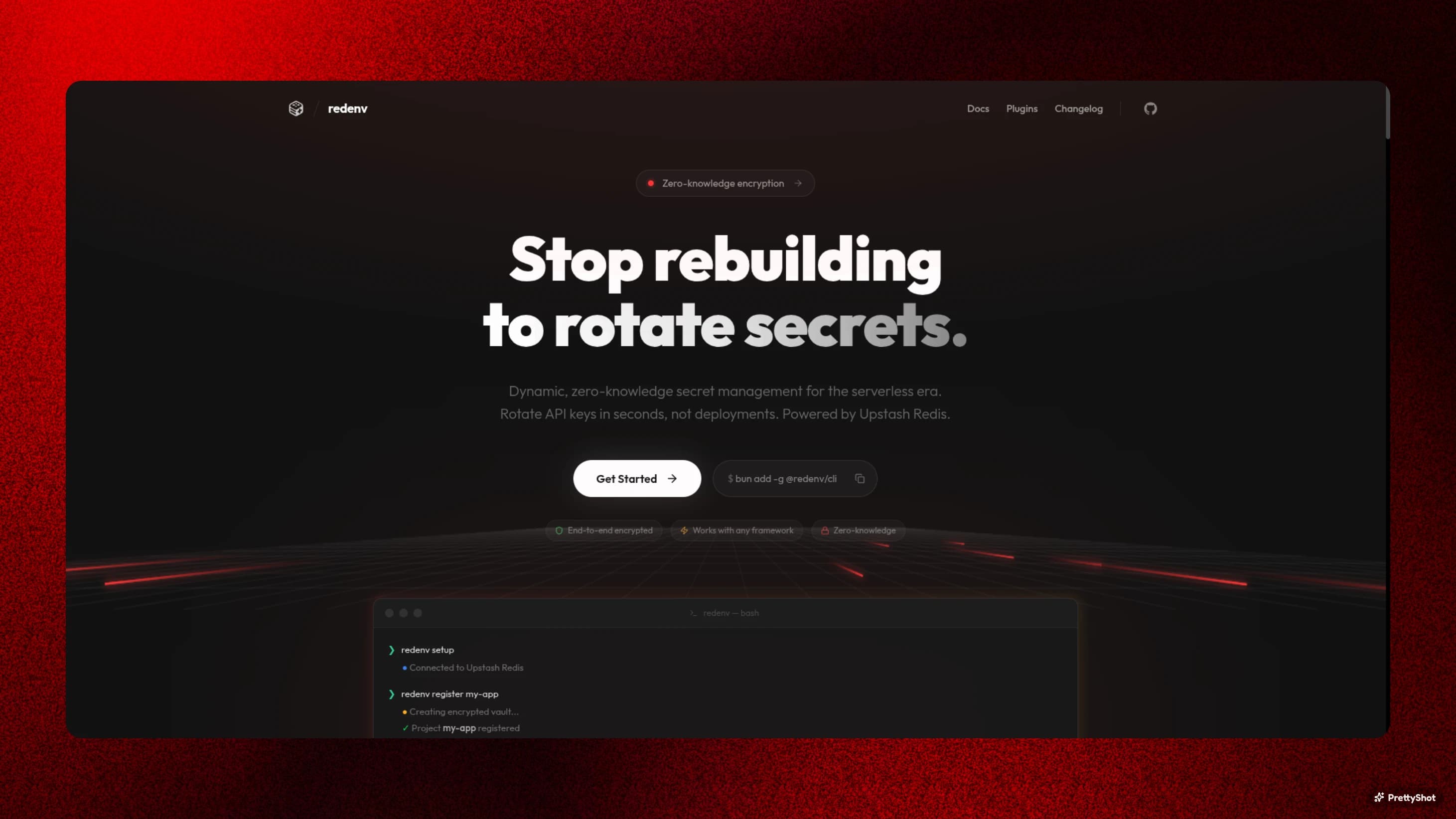
Redenv started from a real pain I kept seeing in teams and personal projects. Secrets were everywhere: local .env files, deployment dashboards, old chat messages, and random notes. It worked at first, but after a few months things became messy. One teammate had an old key, another had the updated one, and rotating secrets felt risky because it often needed a rebuild.
I wanted one system that solves both sides of the problem:
- Security: secrets should be encrypted before storage, and plaintext should not touch the database
- Developer experience: updating a secret should feel like changing config, not shipping a new release
That is why I built Redenv as a developer-first, zero-knowledge secret management system where encryption happens client-side and apps can fetch secrets dynamically at runtime.
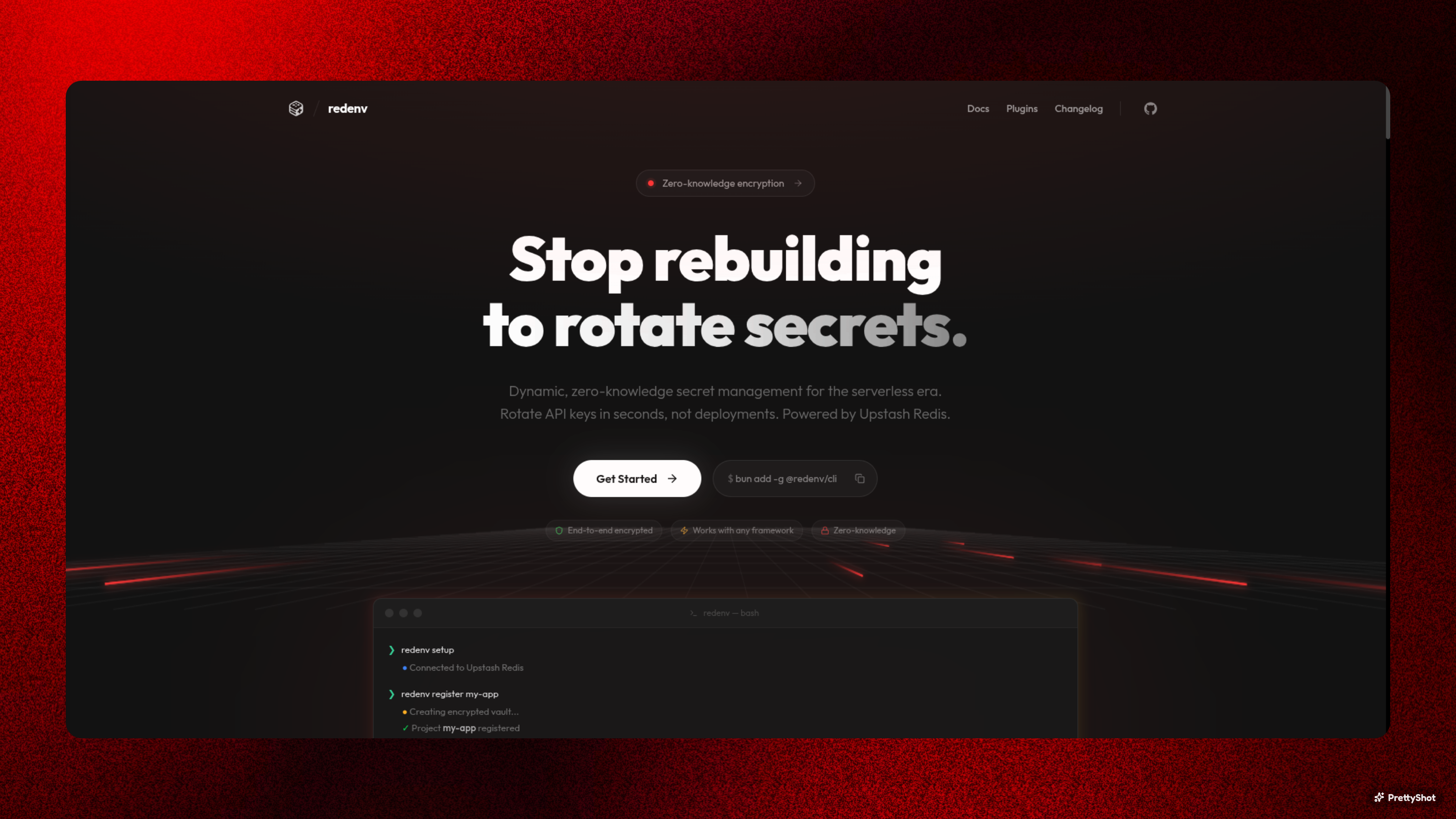
What it does
- Encrypts secrets client-side using Web Crypto primitives
- Stores encrypted values in Upstash Redis with project/environment scoping
- Provides a CLI for add, edit, list, history, rollback, import/export, and token workflows
- Includes
@redenv/clientfor runtime loading with caching and stale-while-revalidate behavior - Supports optional visual management through
@redenv/studio
How it works
Project setup and key generation. During registration, Redenv creates a per-project encryption key. That key is protected by a key derived from your master password.
Encrypt before write. When you add or update a secret, encryption happens on the client side using AES-256-GCM. Redis stores only encrypted values and metadata.
Runtime access with scoped tokens. Apps use service tokens to fetch encrypted data and decrypt in runtime memory. This allows updates without rebuild-heavy workflows.
Under the hood, I use PBKDF2-HMAC-SHA256 key derivation with strong iteration settings and a clean separation between metadata and environment secret records in Redis.
Architecture decisions
I designed Redenv as a small ecosystem instead of one giant package:
@redenv/corefor crypto and shared logic@redenv/clifor operational workflows and team usage@redenv/clientfor runtime loading inside apps@redenv/studioas an optional visual layer
This separation made it easier to test, version, and improve each part independently. It also keeps the runtime client lightweight for production apps.
Key workflows I focused on
Add, update, and inspect secrets fast from the CLI. I focused on commands that map to real day-to-day work so developers can manage secrets without opening multiple dashboards.
Secret history and rollback are built in. If a bad value gets deployed, you can inspect versions and recover quickly instead of debugging blind.
Service tokens and environment scoping allow safer sharing patterns. Teams can separate development/staging/production behavior without duplicating unmanaged .env files.
Challenges while building
- Balancing security and UX: strong crypto is useless if daily usage feels painful
- Cross-runtime compatibility: making Web Crypto behavior reliable across Node and modern runtimes
- Versioning model: keeping history useful without making read/write operations complicated
- Dynamic loading: avoiding latency spikes using cache + stale-while-revalidate strategies
These constraints shaped many implementation details and helped me think more like a product engineer, not just a feature builder.
Why this project matters
On serverless platforms, changing a secret often means opening a dashboard and triggering a rebuild. Redenv decouples that process by allowing apps to read updated secrets at runtime while keeping the zero-knowledge model intact.
For me, this project is important because it combines security engineering, DX design, and system architecture in one product. It is not only about encrypting data, it is about building a workflow developers actually want to use every day.
The goal is simple: make secret management more secure and more practical for real teams shipping fast.