
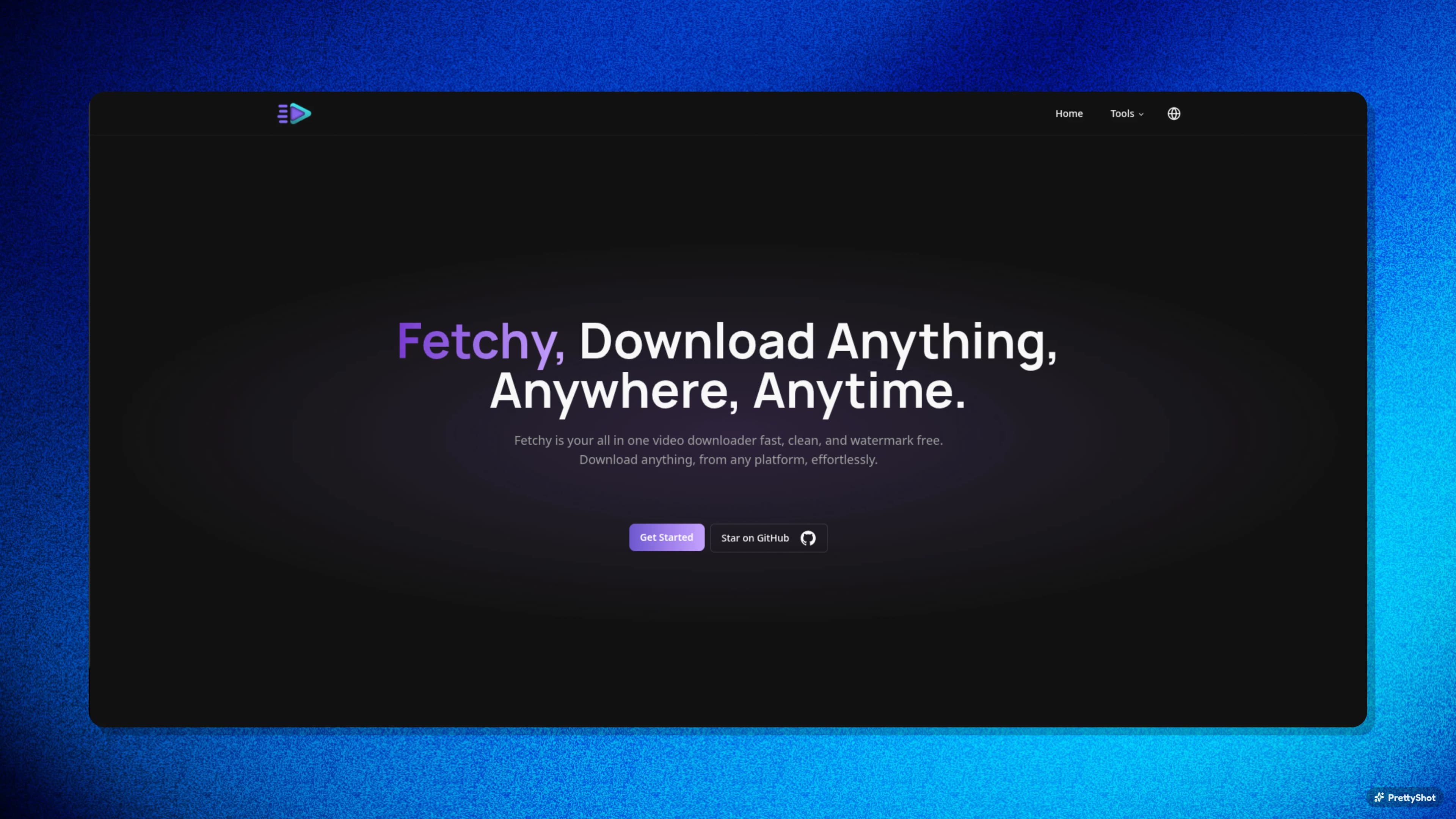
Fetchy started as a simple Node.js project back when I was learning web development. It could download videos from YouTube and Instagram, and that was about it. The UI was basic, the code was messy, and it did the job.
But I kept using it myself. And every time I needed to grab a TikTok video or a Facebook reel, I'd think about what Fetchy could be if I actually rebuilt it properly. So I did. Three times.
The current version, codenamed Neon, is a full rewrite with a proper architecture, a plugin system for tools, and support for Instagram, TikTok, Facebook, and YouTube. It's free, open source, and has no signup requirement.
How it works
Paste a link from any supported platform, and Fetchy extracts the media for you. Videos, photos, reels, stories, carousels, slideshows. You pick the quality and format, then download.
Download posts, reels, carousels, stories, and highlights. Fetchy handles both public and private-looking pages that require session context on Instagram's end. You get the full resolution media, not a compressed preview.
Download videos with or without watermark, extract audio as MP3, and handle slideshows. Paste the TikTok link, and Fetchy pulls everything it can find.
Download videos, reels, stories, and highlights from Facebook. Supports both public posts and pages that normally require login to view.
The evolution
Fetchy has gone through three major rewrites. Each version taught me something new about building software.
v1 was a Node.js + Express app with server-rendered EJS templates. Basic video downloading for YouTube and Instagram. It worked, but the codebase was rough.
v2 moved to Next.js with Tailwind CSS. Added rate limiting, better error handling, and a cleaner UI. But the architecture was still tightly coupled.
v3 (Neon) is the current version. Full rewrite with Next.js 15, a custom plugin system for tool metadata, FumaDocs-powered blog, i18n support, and a unified API response format across all download endpoints.
Starting with v3, each major release is named after an element from the periodic table. Neon, Argon, Zinc, Copper, and so on.
What powers it
The download pipeline works like this: when you paste a URL, Fetchy's API scrapes the platform, uploads the media temporarily to Cloudinary, and generates a short-lived CDN link through a Cloudflare Worker with KV storage. The original source URL is never exposed to the user.
Temporary storage only
Downloaded media is cached on Cloudinary temporarily. Nothing is stored permanently. The CDN keys in Cloudflare KV expire automatically.
Upstash Redis handles two things: logging every API call (success logs auto-expire, error logs persist until resolved) and rate limiting to prevent abuse.
The tool system is one of the more interesting parts. Each download tool (Instagram, TikTok, etc.) has its own meta.ts frontmatter file. A custom Next.js plugin collects all this metadata at build time and maps it into a central store, so adding a new platform is just a matter of creating a new folder with the right files.
What I learned building this
- Rewriting is fine. Each version of Fetchy was better because I understood more. v1 taught me how HTTP works, v2 taught me component architecture, v3 taught me how to build systems that scale.
- Plugin systems pay off. Building the frontmatter + mapper plugin system took time upfront, but adding new tools now takes minutes instead of hours.
- i18n from day one. Adding internationalization later is painful. Fetchy Neon has it baked in with
next-intl.